Trending

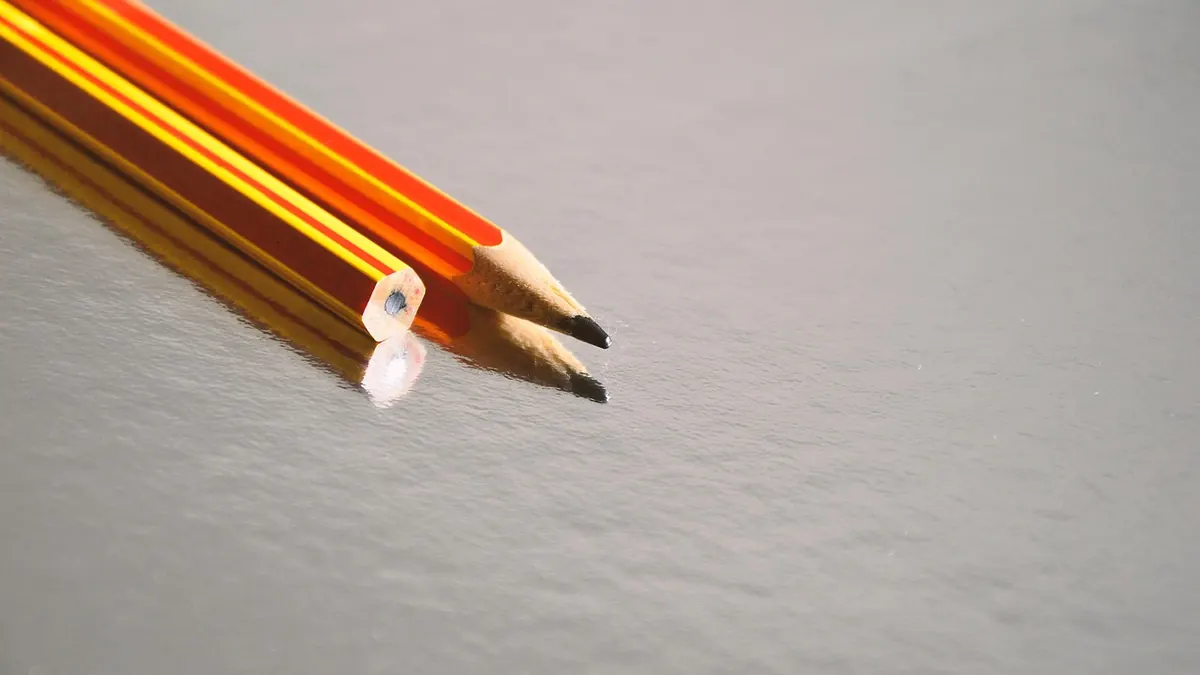
Turn a pencil over and you will find a small stamp near the end: 2B, 4H, HB. Plenty of sketchers ignore it for years, then wonder why their shading looks scratchy or their outlines smear into a grey fog. Those letters are not a quality rating. They tell you how the graphite inside will behave on paper — how dark it goes, how long it holds a point, and how easily it lifts when you change your mind.
Pencil lead is a mix of graphite and clay. Graphite makes the mark; clay binds it and adds hardness. A pencil with more clay lays a pale, fine line and keeps its point for ages. A pencil with more graphite deposits more material, so the marks come out darker, softer and wider.
H stands for hard, B stands for black, and HB sits in the middle where most everyday pencils live. You will also meet F, for fine — a slightly harder HB that holds a point a little longer, which is why it turns up in technical drawing sets.
The numbers work like a dial away from the centre. A 6B is softer and darker than a 2B. A 6H is harder and lighter than a 2H. The full scale runs from 9H at the hardest end to 9B at the softest, and the pencil you reach for most often probably sits somewhere between 4H and 4B.
Hard pencils are the ones for light, controlled work. A 2H or 3H gives you faint silver-grey lines that are easy to work over and easy to erase, which makes them ideal for laying out a drawing before anything permanent happens. A 4H or 6H will hold a needle-sharp point through a long session of hatching, and the crisper grades are useful for architectural forms, technical sketches and fine parallel lines.
The catch is pressure. Hard graphite pressed firmly into the paper scratches the surface, and those grooves stay there. Every soft layer you add afterwards will catch in them and darken, which is rarely what you want. Use H grades with a light hand, and keep them away from rough paper, where they feel scratchy and sound worse.
Soft pencils do the heavy lifting in a sketch. A 2B gives you a dark enough line for a confident outline while still holding a reasonable point. Step up to 4B or 6B and the graphite starts to glide: fewer strokes, richer darks, and much easier coverage when you are blocking in a large shadow. An 8B or 9B is almost waxy, laying down dense black fast, and it will blunt within minutes if you try to draw anything small with it.
Soft grades smudge. That is half their charm and half their problem. Rest a clean sheet of paper under your drawing hand, or work from top to bottom if you are right-handed, or from top-right to bottom-left if you are left-handed. A kneaded putty eraser lifts soft graphite without tearing the paper or leaving crumbs.
Start with an HB or a B for the drawing you intend to keep, and a 2H for the scaffolding you plan to erase. Both keep a point well, so your lines stay crisp and your mistakes come up cleanly with an eraser.
Build in layers, working from hard to soft. Establish mid-greys with an HB or 2B, then bring in a 4B and 6B for the deepest shadows and a 2H for the lightest passages where you barely want a mark at all. Going over a soft layer with a hard pencil tends to drag graphite around and can polish the surface, so save the hard grades for the early stages.
Anything small — individual hairs, eyelashes, brickwork, the tiny marks that give a sketch its texture — wants a 2H through HB sharpened to a long point. Soft pencils simply cannot hold the edge you need, and you will end up with a soft, vague line where you wanted precision.
A workable set is five: 2H, HB, 2B, 4B and 6B. That covers light construction, everyday drawing, mid tones, shadows and dramatic darks. Add an 8B later if you like your contrasts heavy, or a graphite stick if you want to cover large areas quickly.
Buying cheap pencils is a false economy. Budget graphite is gritty and inconsistent, so the same grade feels different from one stick to the next and scratches the paper instead of gliding across it. A modest set from a proper art brand will last months and behave predictably, which matters far more than owning twenty grades.
Pressure. A 6B used gently looks very much like a firm HB. Learning to control the weight of your hand gives you more range than swapping pencils does, and it saves your paper from indentation.
Sharpness. A long point draws fine lines; a blunt tip makes broad, soft ones. Sharpening with a craft knife gives you a longer, more controllable point than a standard sharpener, and a small sandpaper block keeps it that way between sharpenings.
Paper. Smooth Bristol board makes soft pencils look flat and lets hard pencils skate across the surface. Rougher cartridge paper eats into a 6B beautifully and shows every bit of tooth. If a pencil feels wrong, the paper is often the reason.
Take one sheet and draw six small squares. Fill each with a different grade — 2H, HB, 2B, 4B, 6B, 8B — pressing lightly at one end of the square and firmly at the other. You will see instantly how much each pencil can do on its own, and where the overlaps are. Then draw a simple sphere and try the same three- or four-pencil sequence you keep reading about: hard for the light side, HB for the middle, soft for the shadow underneath.
Do that once and the H and B scale stops being a mystery. It becomes a set of tools you choose from on purpose, rather than whatever happens to be nearest in the tin.
Photo: GeriArt / Pixabay